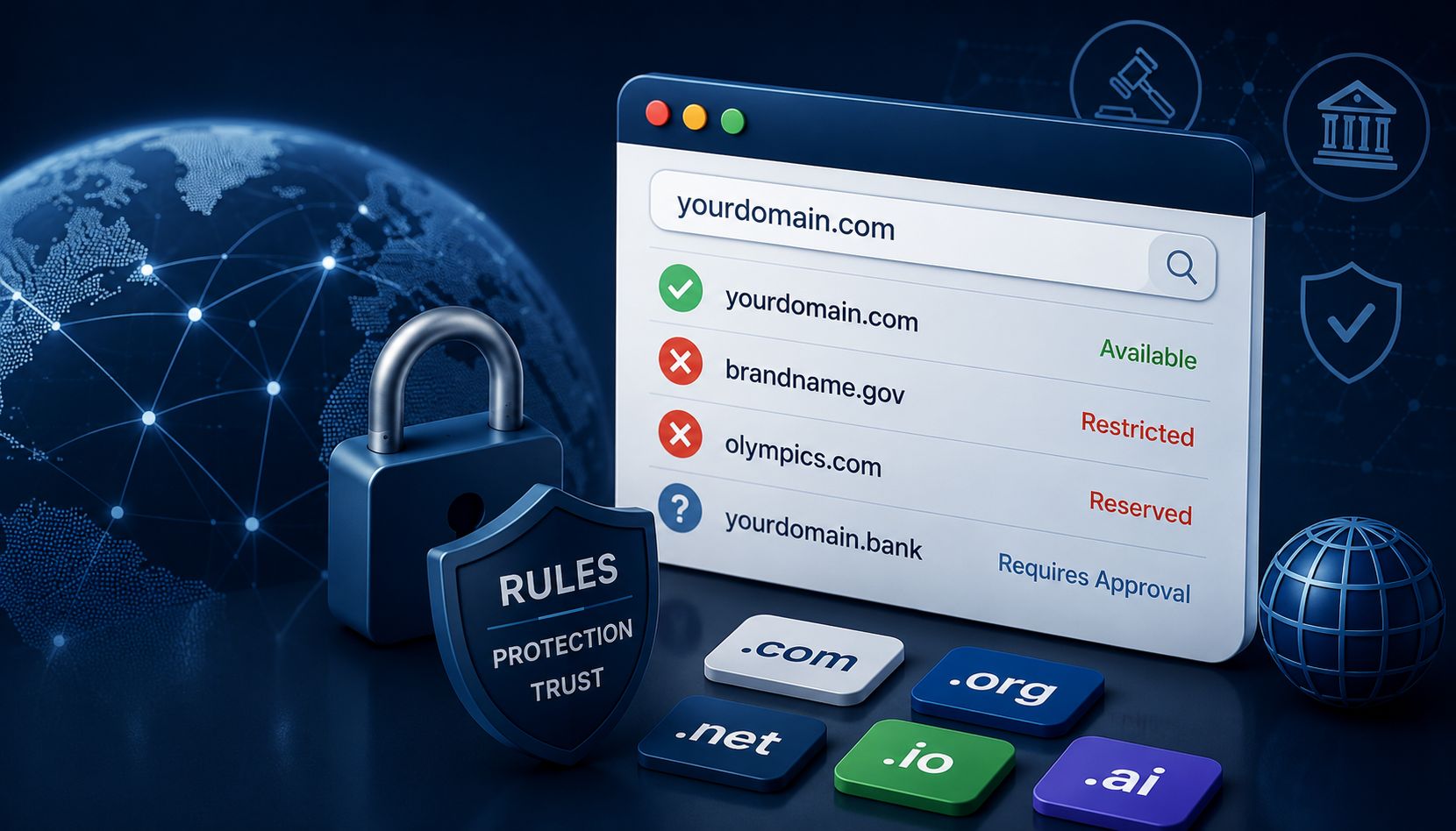
At first glance, registering a domain seems straightforward. You check whether the name you want is available. If it is, you register it. If it isn’t, you simply choose another one.
In most cases, that’s exactly how it works.
But not always.
Some domain names cannot be registered even though they aren’t currently registered. Others may be registered but not remain yours forever. Still others are never available for public registration at all.
What’s going on here?
The Internet was designed as an open system, but openness has always depended on clearly defined rules. Without them, domain registration would quickly become a race in which the fastest person to register a name would always win. Instead, the Domain Name System has evolved over decades to balance openness with stability, security, and trust.
Most Internet users will never notice those rules, yet they are one of the main reasons the Internet continues to operate as reliably as it does today.
Understanding those rules starts with understanding how domain registration actually works.
If you’re looking for more guidance before registering a domain, you may also find these articles helpful:
– Choosing the right domain name,
– Selecting the right top-level domain (TLD),
– What to Consider Before Registering a Domain
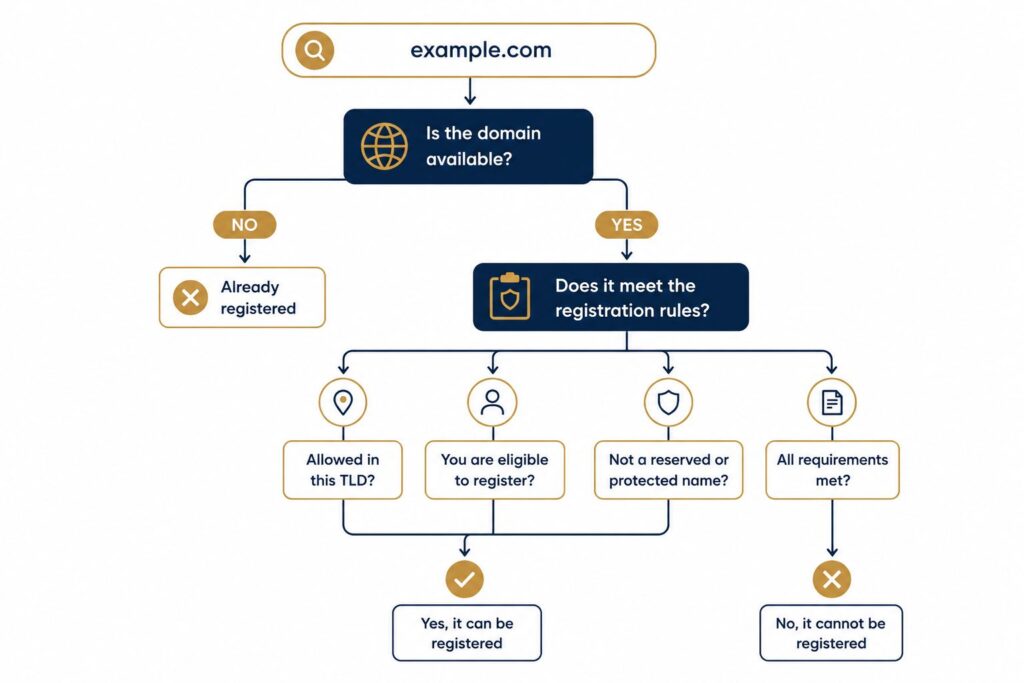
A domain availability check only tells you whether a domain appears to be available. Whether it can actually be registered depends on the registry rules and registration policies that govern that particular domain.
Why an Available Domain Isn’t Always Registrable
The diagram below illustrates the decision process behind domain registration, showing why an available domain is not always eligible for registration.
Every Top-Level Domain Has Its Own Rules
One of the biggest misconceptions about domain registration is that the same rules apply to every domain.
They don’t.
Every top-level domain has its own registration rules that determine what can be registered, who can register it, and under which conditions. That’s why the same name may be available under one extension but unavailable under another.
Certain country-code domains can only be registered by residents or businesses in a specific country, while others are open to anyone. Some country-code extensions, such as .ai and .me, have grown far beyond their original purpose and are now used by businesses and individuals around the world.
Some restrictions are far less obvious. Within some generic top-level domains, country and territory names are reserved and cannot be registered freely. Similar protections apply to certain international organizations, including the International Olympic Committee and the International Red Cross and Red Crescent Movement.
Not every top-level domain is open for public registration either. Google’s .gle domain is a good example. Although it exists and is actively used, it isn’t available for public registration.
Registration rules also extend beyond eligibility requirements. Internationalized Domain Names (IDNs) allow domains to use scripts such as Arabic, Chinese, or Cyrillic, while the DNS continues to process them internally using their ASCII representation.
If you’re choosing a top-level domain for a new project, understanding how different extensions are intended to be used can help you make a better long-term decision.
Although these rules may seem restrictive at first, but they exist to protect the stability of the domain name system, reduce abuse, and ensure that names of public interest do not simply end up in the hands of whoever registers them first.
Common Categories of Restricted Domains
The table below highlights some of the most common situations in which a domain name is restricted or reserved. Although the rules vary between registries, the underlying principle is the same.
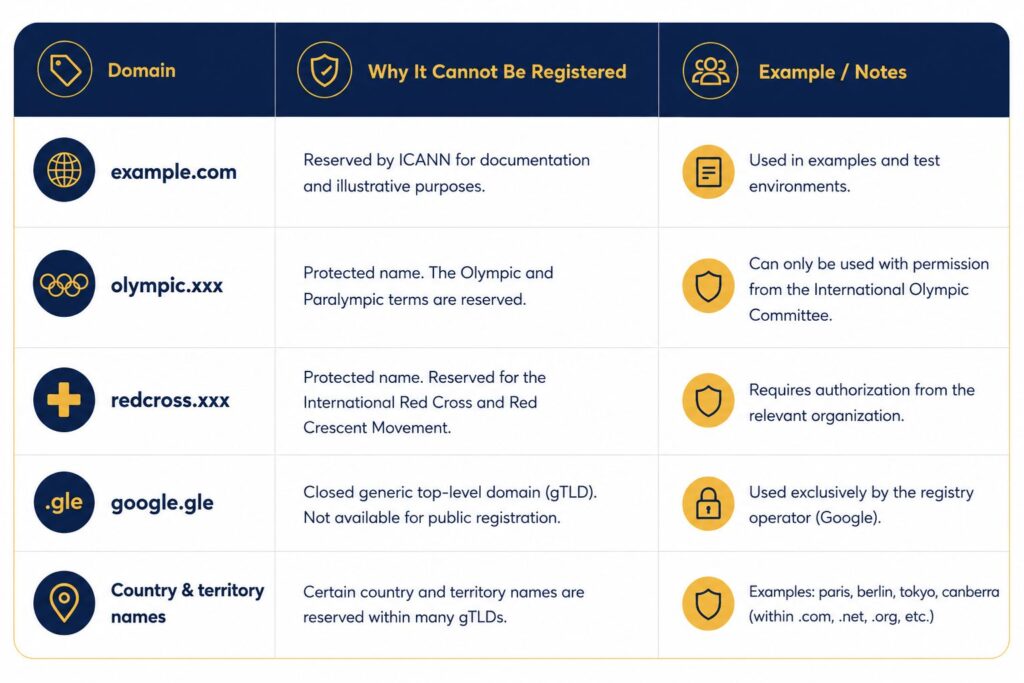
An “Available” result doesn’t simply mean that nobody has registered the name yet. It also means the requested registration complies with the rules governing that particular domain.
Who Actually Controls Domain Registration?
The Three Organizations Behind Every Domain
The domain registration system is built around three key participants: ICANN, registries, and registrars. Each has a different role in ensuring that domain names are managed consistently across the Internet.
At the top is ICANN (Internet Corporation for Assigned Names and Numbers), the non-profit organization that coordinates the global domain name system. It doesn’t sell domain names or decide who gets to register them. Instead, it provides the framework that allows the entire system to operate consistently.
Within that framework are the registries, the organizations that manage individual top-level domains such as .com, .org, and .net. They maintain the official database of registered names and define the registration rules for each extension.
Finally, there are the registrars, the companies people use to register domain names. Their role isn’t to make the rules, but to apply them.
Why Most People Never Notice This System
Most people never think about who manages their domain, and they don’t need to. When everything works as intended, the infrastructure behind it remains almost invisible.
If you’re curious about what happens after you type a domain name into your browser, we’ve explained the process in our article on how DNS works.
Registering a Domain Is Just the Beginning
Registering a domain may feel like the final step, but it’s really the beginning. Once you’ve chosen a name, selected the right top-level domain, and successfully completed the registration process, your domain becomes part of your business.
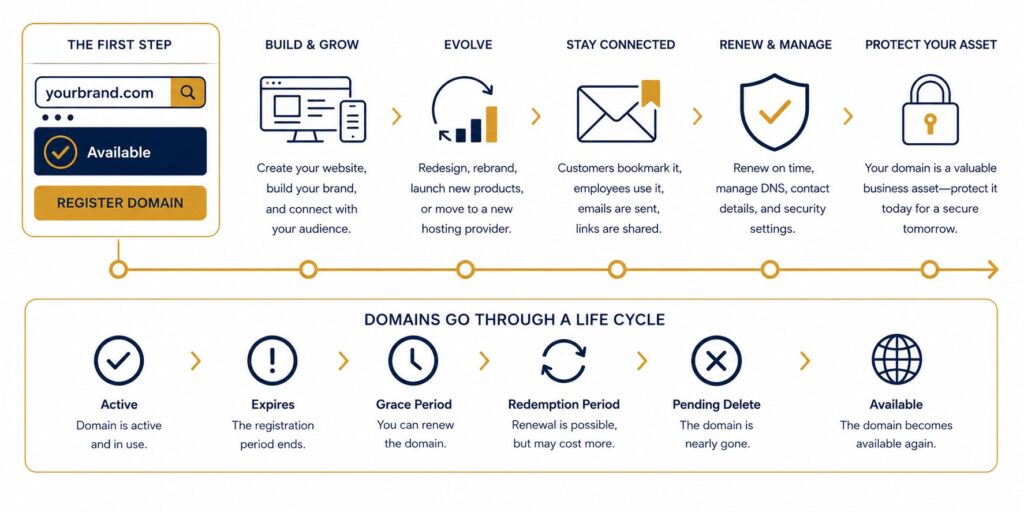
A company may redesign its website several times, change its logo, launch new products, or even move to a different hosting provider. Yet the domain name often remains the same throughout its entire history. Customers bookmark it, employees use it every day, and countless emails, search results, and links become associated with it over time.
A domain needs to be renewed on time, managed responsibly, and protected like any other important business asset. Missing a renewal doesn’t necessarily mean losing it immediately, as most domains pass through a well-defined lifecycle before becoming available again. Learn more in our guide to the Domain Life Cycle.
Registering a domain isn’t simply about securing an available name. It’s about making a decision that may represent your business for years—or even decades—to come.
Final Thoughts
Most people will never think about domain registration again after securing their first domain. And that’s exactly how the system is meant to work.
The rules behind the Domain Name System exist for a reason. They help keep domain registration stable, secure, and fair across millions of registrations worldwide. Without them, registering a domain would quickly become a race where the winner is simply the person who reaches the keyboard first.
The next time you check whether a domain is available, remember that availability is only the first step. Every registration must also comply with the rules and policies that govern that particular top-level domain.
Today, millions of domain names are registered every year without anyone ever realizing there was a race to begin with. Perhaps that’s the clearest sign that the system is working exactly as intended.