
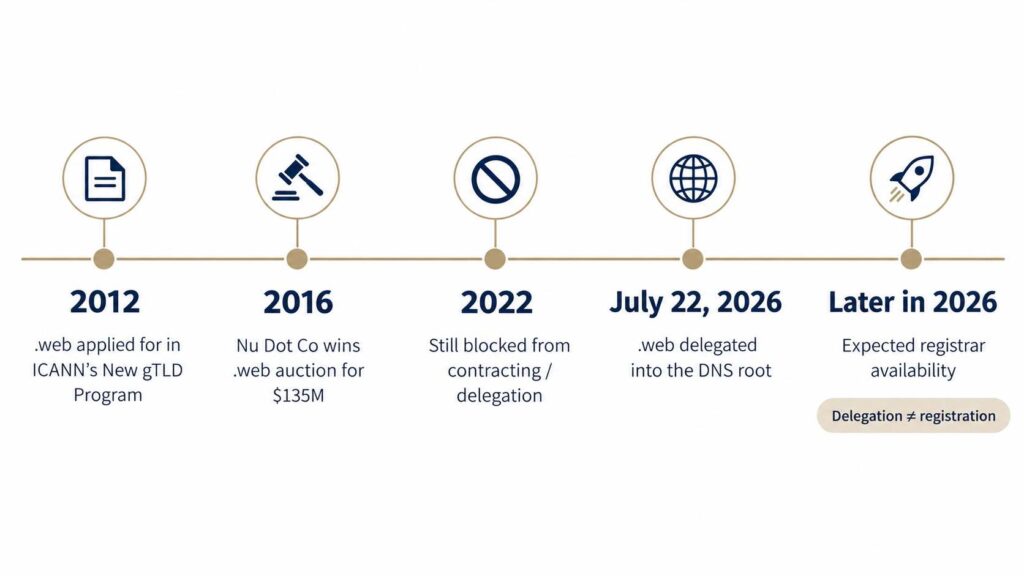
.web was submitted during ICANN’s 2012 New gTLD Program, and four years later Nu Dot Co won the ICANN auction of last resort with a $135 million bid. It was an extraordinary bid for the right to move forward with the application, but winning the auction still left .web a long way from registrars.
Another ten years passed before Verisign announced, on July 22, 2026, that .web had finally been delegated into the global DNS root with Verisign as the registry operator. Even now, .web domains are not yet available for general registration, and Verisign says it plans to begin offering them through channel partners later in 2026.
What makes the .web story particularly relevant now is that ICANN has just closed the application window for its 2026 New gTLD Round after receiving more than 1,600 primary applications. Before that new list of strings appears on Reveal Day, .web is a useful reminder of how much can happen between applying for a TLD and actually seeing domains available for registration.
We were already talking about .web in 2012
Looking back through the WhoAPI archive gives this story an interesting perspective, because we were already talking about .web when the original applications were still new.
In September 2012, I interviewed Paul Stahura, who had founded eNom and was then involved with Donuts, one of the largest applicants in the first New gTLD Program. Donuts had applied for more than 300 extensions, and .web was among the strings I mentioned at the time alongside .app, .blog, .cloud, .domains and .shop.
A few months earlier, I had also asked Rick Schwartz which of the new extensions he thought had the most potential. He did not try to predict a winner, but he pointed to .web as the kind of generic extension that made sense because almost any word, company name or personal name could work naturally in front of it.
Fourteen years later, we know how differently that first wave of new gTLDs performed. Some became substantial registries, many remained relatively small, and more than 1,200 new generic top-level domains ultimately entered the namespace. We recently looked back at how much the domain landscape has changed since 2011, and the expansion of the namespace was a large part of that change.
.web was still missing.
The $135 million auction was only one step
Seven applicants had applied for .web, and because they did not resolve the competition privately, the string went to an ICANN auction of last resort in July 2016. Nu Dot Co won with its $135 million bid, while Vistaprint won .webs in the same auction for just $1.
Verisign later disclosed that it had funded Nu Dot Co’s bid under an arrangement that could eventually transfer the registry agreement to Verisign. Other applicants challenged the arrangement, beginning years of ICANN accountability proceedings and Independent Review Processes that kept .web from moving forward.
By 2022, ICANN was still not moving forward with contracting or delegation.
The auction settled the competition between applicants, but it did not put .web in the DNS root.
Fourteen years later, .web reached the root
On July 22, 2026, Altanovo Domains withdrew the remaining Independent Review Process concerning .web, and on that same date Verisign announced that the extension had been delegated into the global DNS root.
Verisign said the delegation followed the successful resolution of all previous disputes related to .web, although the details of those resolutions remain confidential. IANA now lists .web as a delegated generic top-level domain with Verisign as the sponsoring organization.
Fourteen years after the original application, and ten years after the auction, .web was finally part of the DNS root.
Delegated does not mean available
Delegation means that a TLD has been added to the DNS root, but it does not automatically open second-level registrations to the public. At the time of writing, .web domains such as example.web are not yet available for general registration, and Verisign says it plans to begin offering them through registrar partners later in 2026.
We recently looked at why an unregistered domain is not always a domain you can actually register, because registry policies, reserved names or eligibility requirements can still prevent registration.
.web shows a similar distinction one level higher in the DNS hierarchy: the extension now exists in the root, while commercial registrations beneath it have not yet opened.
The 2026 New gTLD Round has only just started
ICANN closed the application window for the 2026 New gTLD Round on August 12 after receiving more than 1,600 primary applications. Once the administrative checks are complete, Reveal Day will publish the applied-for strings and show where multiple applicants may be competing for the same names.
The evaluation fee alone is $227,000 per application, but paying that fee is only entry into the process. Applicants still have evaluations to pass, possible objections and contention to resolve, followed by contracting and technical onboarding before a successful TLD can reach the root.
Most of those applications will not follow the fourteen-year path taken by .web, whose circumstances were exceptional. Still, when Reveal Day arrives, the list should be read as a list of applications rather than a catalog of new extensions simply waiting to be switched on.
Conclusion
For most of the last fourteen years, the interesting questions around .web were about the process: which applicant would prevail, who would ultimately operate the registry and when the extension would finally reach the DNS root. Most of those questions now have answers, which leaves one the ICANN process cannot answer for us: will registrants actually want .web domains?
When Rick Schwartz mentioned .web in 2012, his reasoning was that a broad, generic extension had an advantage because so many words and names could work naturally in front of it. I still think there is something to that argument, but .web is entering a very different market from the one in which the original application was filed. Registrants have had more than a decade to become familiar with hundreds of new extensions, and we now know how differently individual new gTLDs can perform.
The $135 million auction bid tells us how much competing applicants were willing to put behind the right to operate .web, while the decade that followed shows how far even a winning application can sometimes remain from a delegated and commercially available TLD.
Once registrations open, .web will face a very different test. Fourteen years after the original application was filed, we will finally see whether domain buyers still see enough value in those three letters to choose .web for their own domains.