
On September 22, 2026, ICANN confirmed that 1,616 applications will move forward in the 2026 New gTLD Round, out of 1,663 applications originally submitted. These are the applications for which ICANN received the required fee, a condition for continuing through the program.
We know the size of the round. What we still do not know is what those applicants actually want to put to the right of the dot.
That changes on Reveal Day.
ICANN will then publish the public-facing portions of the paid applications, including the applied-for strings and information about strings that may be in contention. Barring extraordinary circumstances, ICANN expects Reveal Day to take place no later than October 14, 2026. ICANN has also cautioned that its own data will be the only complete and verified source for the round.
In our recent article about .web and its fourteen-year journey to the DNS root, we looked at how much can happen between submitting an application and eventually operating a top-level domain. The 2026 round now gives us an opportunity to watch that process from the beginning.
Reveal Day Is a Snapshot, Not a Launch List
Reveal Day is when the round becomes visible to the rest of the domain industry. We will finally see the proposed extensions, who applied for them, and the public portions of the applications behind them.
ICANN will also identify contention sets involving identical applied-for primary strings or their variant strings. Those sets are not necessarily final. They can change later as a result of string similarity evaluation, singular/plural notifications, objections, and other parts of the process. ICANN’s 2026 Applicant Guidebook explains how contention sets are formed and resolved.
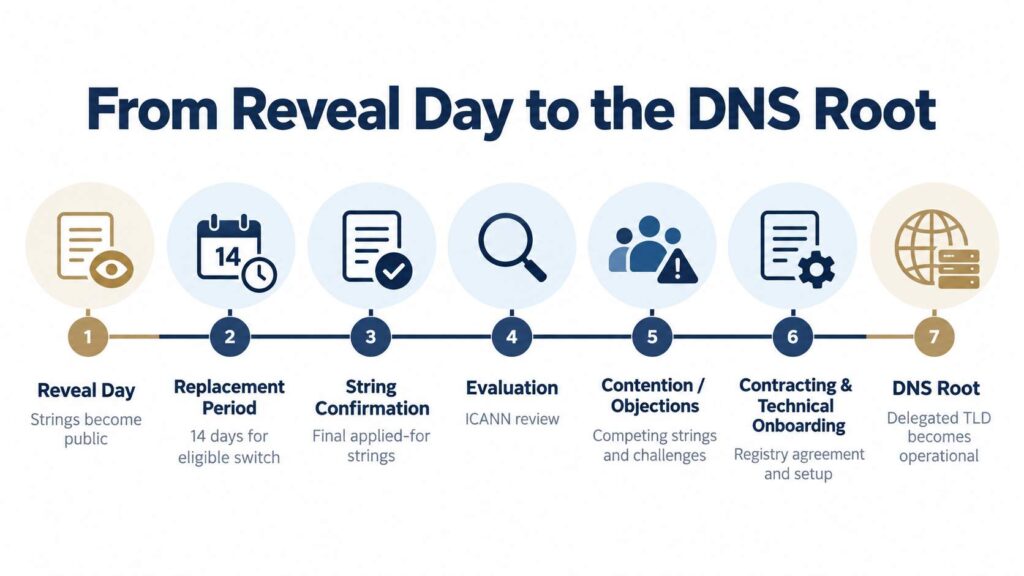
There is another reason not to read Reveal Day as a final list. Applicants that submitted an eligible replacement string will then have 14 days to decide whether to use it. Applicants that switch cannot return to their original string, while those that do not switch during the Replacement Period lose that option. ICANN then publishes the finalized list of applied-for strings on String Confirmation Day.
Evaluations, objections, contention resolution, contracting, and technical onboarding still come later. Only after delegation does an applied-for string become an operational TLD in the DNS root.
That makes Reveal Day valuable for a specific reason: it shows us what applicants want to build.
Contention Shows Where Applicants See Value
One of the first things I will look at when the list appears is contention.
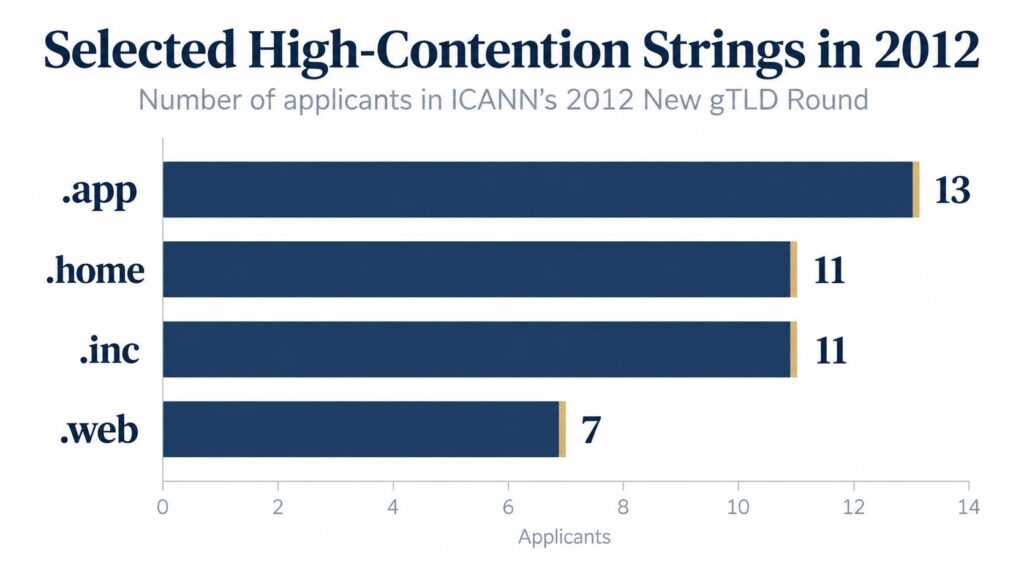
ICANN received 1,930 applications in the 2012 round. On Reveal Day, 230 strings had more than one applicant, involving 751 applications. Some of the competition was substantial: .app attracted 13 applications, .home and .inc received 11 each, and .web had seven.
Fourteen years later, those figures are interesting for a different reason.
They show where applicants believed there was enough commercial or strategic value to compete for the same part of the namespace. That is not the same as demand from registrants, as the history of the first round eventually showed.
If several unrelated companies apply for the same generic term in 2026, I will pay attention. That reveals how those applicants see the opportunity, but very little about how the extension will perform years later.
The rules for resolving that competition are also tighter this time. The 2026 Applicant Guidebook makes ICANN’s formal contention-resolution process the permitted path: private auctions, joint ventures, and other arrangements intended to settle contention privately are prohibited. Certain communications between applicants in the same contention set are also restricted beginning on Reveal Day.
That should make the most heavily contested strings particularly interesting to follow.
Different TLDs Are Built for Different Jobs
Registration volume is another number that needs context.
A broad generic extension may depend on attracting a large public registration base. A company applying for its own brand may have no reason to pursue that model at all. The value of a .brand can come from controlling the namespace and using it for products, services, or corporate infrastructure rather than selling domains through registrars.
We have looked at that model before with .alibaba and other brand TLDs.
Geographic and internationalized applications require a different lens. WhoAPI has followed internationalized and geographically focused namespaces for years, and we previously looked at how IDNs extend the namespace beyond Latin script while geographic TLDs create locally focused domain spaces.
This is why I would not approach the Reveal Day list by trying to identify the “best” strings. A public generic registry, a city TLD, and a corporate brand namespace can all make sense while serving completely different purposes.
The more useful question is what each applicant is trying to build.
A Larger Namespace Also Means More Domain Data
There is another side of a new gTLD round that gets less attention because most domain users never see it directly.
Every successful new TLD adds another registry zone, with policies and registration data that domain-data systems must support, even when multiple TLDs share the same backend provider.
To someone registering a domain, that may simply look like another choice after the dot. For software working with domain information at scale, it is another namespace whose data and technical behavior have to be handled consistently.
As of August 31, 2026, ICANN lists 1,241 delegated gTLDs from the 2012 round, while four applications from that round were still proceeding through the program.
We recently looked at this broader shift in 15 Years of Domain Data: From WHOIS to RDAP. The expansion of the namespace happened during the same period in which registration data was moving from traditional WHOIS toward RDAP and more structured, machine-readable responses.
For a domain data provider, those developments are connected. More TLDs mean more registry zones, policy variations, and data sources that software must normalize and interpret consistently across thousands or millions of domains.
It is the same reason domain data that looks simple in a single lookup becomes a different problem at scale.
Successful new TLDs eventually become part of the DNS infrastructure as well. Our earlier explanation of how DNS works follows the path from the root through TLD name servers to the authoritative servers responsible for individual domains.
That is where a string first disclosed on Reveal Day can eventually become part of the infrastructure WhoAPI works with every day.
Conclusion
The 2012 round gives us something we did not have the last time ICANN opened this process: fourteen years of real-world history.
Some extensions built substantial public registries, others remained relatively small, and hundreds of brands approached their TLDs with entirely different goals. Applicants in 2026 are entering the process with years of examples that simply did not exist when the previous applications were submitted.
That is what makes this Reveal Day particularly interesting.
We already know that 1,616 applications are moving forward. Soon we will see which generic terms attracted competition, which companies want their own namespaces, and how much interest there is in geographic and internationalized extensions.
I would not expect that list to tell us what the domain market will look like five or ten years from now.
What it will show us is what applicants decided was still worth building after seeing what happened the last time.