Over the last two years, artificial intelligence has become almost impossible to ignore.
It’s difficult to open a technology website, browse LinkedIn, or read business news without seeing a story about OpenAI, Anthropic, Perplexity, Mistral, or another startup promising to transform the way we work and use technology.
As someone who has spent nearly two decades working with domains, hosting, APIs, and internet infrastructure, I naturally tend to look at technology companies through a slightly different lens.
Instead of focusing on benchmark scores, model comparisons, or funding rounds, I became interested in the digital footprint these companies leave behind through their domains, DNS infrastructure, and publicly available technical data.
At first, it was simply curiosity. I reviewed a few WHOIS records, DNS configurations, and infrastructure-related details to see whether domain and infrastructure data could reveal something about the companies behind today’s most popular AI products.
The more I looked, the more one thing became clear.
Behind some of the world’s most advanced AI models sits surprisingly familiar infrastructure.
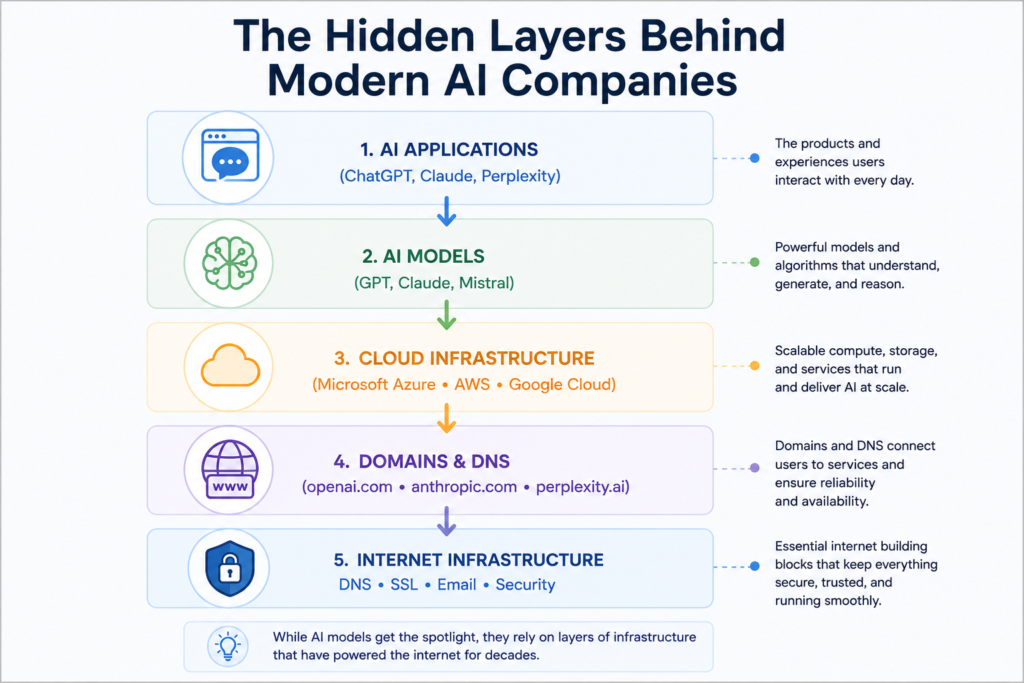
Despite all the attention surrounding artificial intelligence, large language models, and massive data centers, the companies building them still depend on many of the same foundations that have powered the internet for decades — domains, DNS, email infrastructure, and security systems.
And those foundations often reveal far more about a company than most people realize.
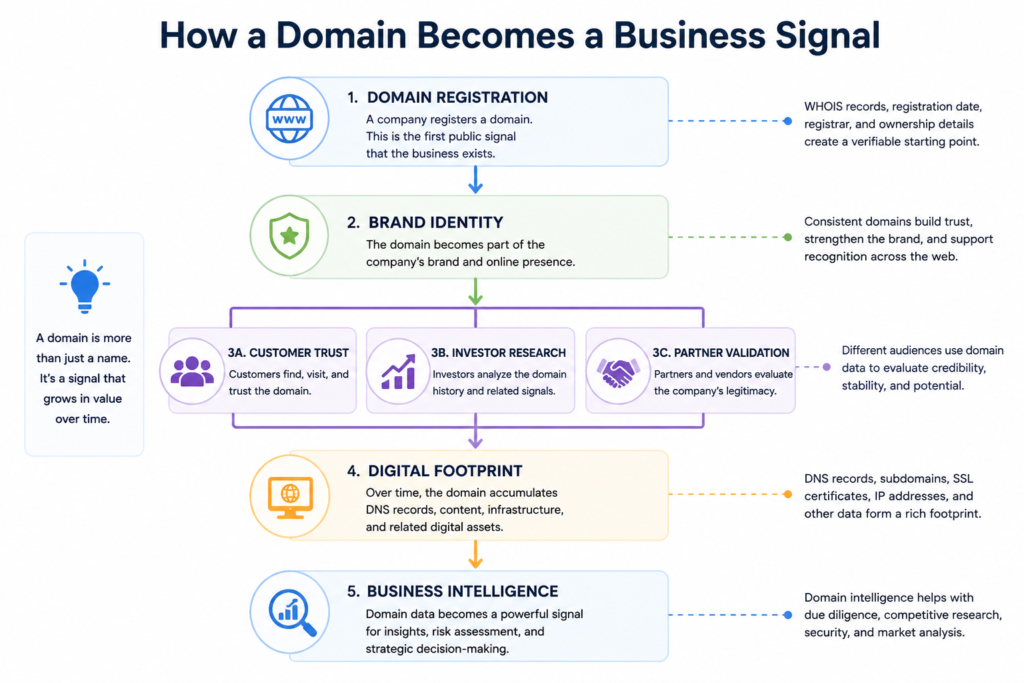
Every AI Company Starts With a Domain
When people think about AI companies, they usually think about models, GPUs, data centers, and infrastructure investments. But long before a company raises capital, launches a product, or attracts media attention, it usually registers a domain.
That domain often becomes one of the first public signals that the company exists.
It becomes the place where future customers discover the product, investors research the business, and partners evaluate its credibility.
Over the years, I’ve learned that domains reveal much more than most people expect. Registration history, domain age, ownership changes, related domains, and DNS infrastructure all contribute to a company’s digital identity.
This is why domain data has become increasingly valuable not only for cybersecurity professionals, but also for investors, brokers, market researchers, and organizations looking to better understand competitors.
What Domain Age Can Tell Us
Earlier this year, we explored how investors and acquisition professionals use domain registration dates during due diligence in our article Why Smart Acquirers Filter Targets by Domain Creation Date.
Of course, domain age alone doesn’t determine whether a company is successful.
Some businesses operate for years without finding product-market fit, while others reach billion-dollar valuations in a surprisingly short period of time.
Domain age provides context.
Domain records create a timeline that is difficult to rewrite. They can reveal when a project began, how long a brand has existed, and how consistent its digital identity has remained over time.
In a world where hype often travels faster than facts, that context can be surprisingly valuable.
Infrastructure Reveals More Than Most People Think
One of the things that stood out while researching leading AI companies was how seriously they approach infrastructure.
Infrastructure is often where you can see whether a company is truly prepared to scale.
Reliable DNS systems, cloud infrastructure, security controls, email systems, and monitoring platforms are rarely visible to end users, yet they often determine whether a service can reliably support millions of people.
Throughout my career, I’ve seen many technology companies build impressive products while underestimating infrastructure.
Users rarely notice when infrastructure is working.
They only notice when it stops working.
That’s one reason infrastructure data remains so valuable. It often reveals how organizations approach reliability, security, and operational maturity.
We discussed this topic in greater detail in What Is DNS and How DNS Works, where we explain why DNS remains one of the most important technologies powering the modern internet.
What Leading AI Companies Have in Common
While reviewing publicly available information about several leading AI companies, I noticed a few recurring patterns.
Although OpenAI, Anthropic, Perplexity, and Mistral compete in the same market, their infrastructure strategies share a common goal: reliability.
After working with internet businesses for nearly two decades, one thing I’ve learned is that successful companies rarely treat infrastructure as an afterthought. The technology changes, but the importance of reliability remains remarkably consistent.
Another interesting observation involves their domains. While their products are very different, the way they approach digital identity is surprisingly similar.
At first glance, a domain may seem like a minor detail. In reality, it often becomes one of the company’s most valuable digital assets.
Customers trust it. Developers integrate it. Businesses depend on it.
And as these platforms grow, attackers increasingly attempt to imitate them through lookalike domains and phishing campaigns.
When we look at their products, these companies appear very different.
When we look at their domains and infrastructure, they often appear remarkably similar.
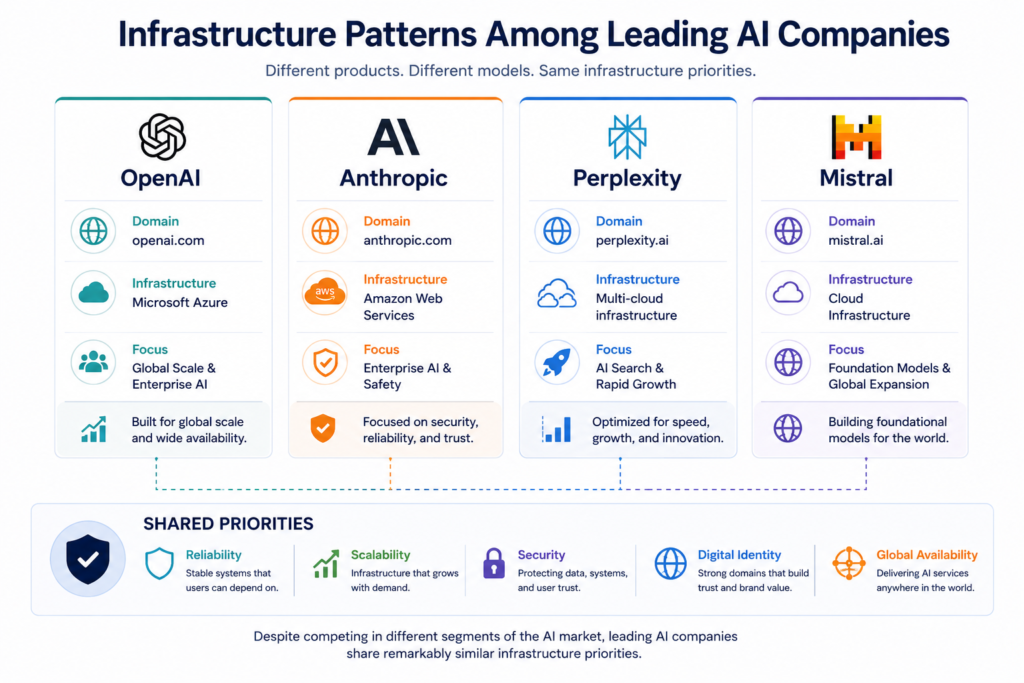
Despite competing in the same market, leading AI companies share remarkably similar infrastructure priorities: reliability, scalability, security, and strong digital identities.
Looking at these companies side by side makes one thing clear: while the products are different, the underlying infrastructure priorities are remarkably similar.
Popular AI Brands Become Targets
One challenge that quickly follows popularity is impersonation.
Whenever a major technology platform gains attention, attackers begin registering similar-looking domains in an attempt to imitate legitimate brands.
The AI industry is no exception.
Fake ChatGPT websites, lookalike AI tools, and phishing campaigns targeting popular platforms have become increasingly common.
Domain monitoring, brand protection, and infrastructure visibility have become important parts of modern cybersecurity.
The growing importance of monitoring digital assets is something we explored in Domain Monitoring: An Important Cyber Security Effort.
As AI platforms continue to attract millions of users, the value of their brands increases as well. Unfortunately, that visibility also attracts attackers looking to exploit trust through phishing campaigns, fake websites, and impersonation attempts.
For security teams, monitoring domains is no longer simply a defensive measure. It has become an important part of understanding and protecting an organization’s digital footprint.
Why Domain Intelligence Matters
At WhoAPI, we’ve spent years helping businesses, developers, researchers, and security teams understand domain-related data at scale.
One thing we’ve learned is that domains themselves are rarely the destination.
They’re a source of signals.
- Signals about trust.
- Signals about security.
- Signals about growth.
- Signals about business history.
- Signals about infrastructure.
That’s why domain data today supports everything from cybersecurity and competitive intelligence to due diligence and market research.
The better we understand an organization’s digital identity, the better we understand the organization itself.
Whether you’re investigating a phishing campaign, evaluating an acquisition target, monitoring competitors, or researching an emerging industry, domain data often provides context that is difficult to obtain elsewhere.
What We Can Learn From AI Companies
The most interesting thing I discovered while looking at leading AI companies had nothing to do with model performance, benchmark scores, or investment rounds.
It had everything to do with the fact that many of the most valuable signals still exist in places most people rarely think to look.
Interestingly, while AI products may be revolutionary, the infrastructure behind them is often built on principles that have powered the internet for decades. And that’s not a criticism — it’s a sign of maturity.
After spending nearly two decades working with domains, hosting, APIs, and internet infrastructure, I’ve learned that some of the most valuable business signals are often hidden in plain sight.
AI companies may be building the future, but the digital footprints they leave behind still follow many of the same patterns we’ve seen across the internet for years.
The headlines focus on artificial intelligence.
Domain data often tells the story behind the companies creating it.
And as long as businesses continue to build their presence on the internet, understanding domains, infrastructure, and digital identity will remain just as important as understanding the technologies built on top of them.