
Until October 7, we knew the size of ICANN’s 2026 New gTLD Round, but not what was behind the number.
In September, ICANN confirmed that 1,616 paid applications were moving forward. In our previous article about the 2026 round, I wrote that the strings themselves would tell us much more than the application count.
Reveal Day gave us that missing part. ICANN’s Application Statistics list 1,615 active applications from 481 applicants. The October 7 snapshot contains one application fewer than the paid total announced in September, and ICANN notes that the final number and types of applications will be confirmed on String Confirmation Day.
Now that the strings are public, what interests me is not simply which words appear after the dot. It is how differently those 1,615 applications are distributed and what that tells us about the companies behind them.
Viewed this way, the applications do not represent a single market.
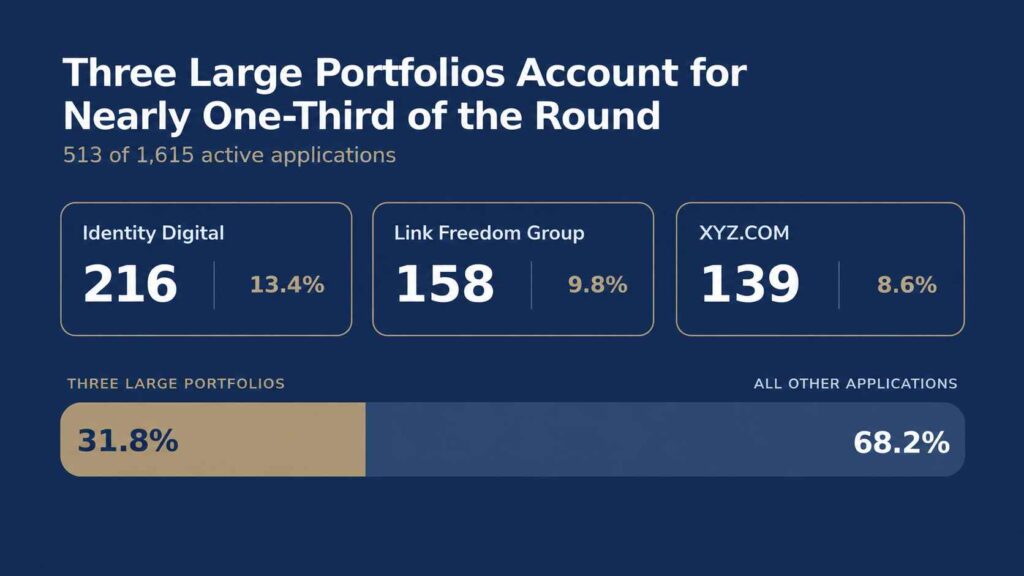
Three Registry Portfolios Account for Almost 32% of the Round
Although the round includes 481 applicants, a small number of registry businesses account for a disproportionate share of the 1,615 applications.
216 applications are associated with Identity Digital, 158 with Link Freedom Group, and 139 with XYZ.COM. Together, those three portfolios represent almost 32% of the entire Reveal Day total.
Those figures are best read at the portfolio level. Some registry groups file through affiliated companies, so the totals do not map neatly onto ICANN’s count of 481 applicants. What matters is not just the size of these portfolios, but the operating model behind them.
For an established registry operator, submitting dozens or even hundreds of applications is a very different business decision from pursuing a single string. Technical infrastructure, registrar relationships, and operational experience can be shared across a portfolio, which can change the economics of each application. Identity Digital’s applications span categories from technology and finance to commerce, travel, professional services, health, and infrastructure. XYZ.COM, which already operates .xyz and dozens of other TLDs, has taken a similarly large-scale approach.
Link Freedom Group offers another example of active portfolio management. On October 8, it said it had replaced 19 primary strings with alternatives during the Replacement Period while keeping its total at 158 applications.
There are also individual strings attracting a lot of attention. .agent, for example, received 13 applications, including applications from Google, Meta, and OpenAI. That makes it a useful example of where applicants currently see strategic value, but although very exciting and I personally like .agent, I would not use one heavily contested string to define the round.
Some applicants are pursuing one or two carefully selected strings, while others are building portfolios across dozens or hundreds of potential namespaces. Both strategies appear in the same application count, but the businesses behind them are doing something quite different.
One in Five Applications Is for a Brand TLD
The concentration among registry operators is only one part of the picture. In its Reveal Day announcement, ICANN also identified 333 brand applications, just over 20% of all applications disclosed on October 7.
Before Reveal Day, we already knew that a corporate namespace and an open generic registry could have very different objectives. What the new data gives us is a sense of how large the brand portion of this round actually is.
WhoAPI has followed this model before, including in our article about .alibaba and other brand TLDs. What I find interesting about the 2026 figure is that companies have now had more than a decade to watch the first generation of brand TLDs develop, and organizations have still submitted hundreds of brand applications in this round.
That does not mean all 333 proposed brand namespaces will eventually be used extensively. Some successful applicants may operate only a relatively small number of domains, which is why I would be careful about using registration volume as a universal measure of success for this round.
A registry selling domains to the public and a company controlling a corporate namespace can produce completely different registration numbers while still achieving their respective goals. The 333 brand applications make that more than a theoretical distinction.
The Global Round Is Still Geographically Concentrated
The regional numbers become more interesting when applicants and applications are compared side by side.
North America and Europe account for 309 of the 481 applicants, or about 64% of the total. But those same two regions account for 1,370 of the 1,615 applications — almost 85%. That gap suggests that larger application portfolios are disproportionately concentrated in North America and Europe.
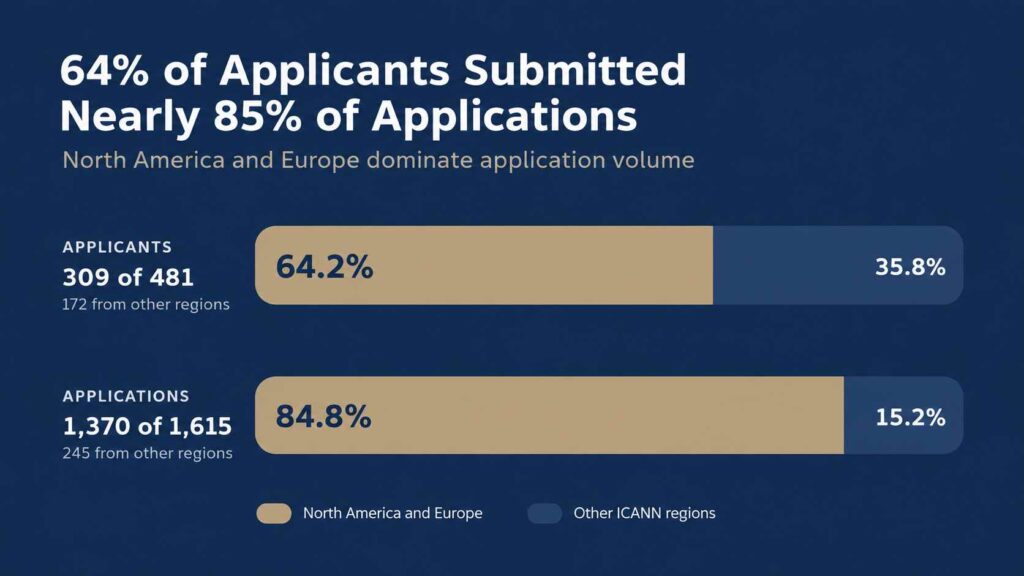
The regional application totals are 864 for North America and 506 for Europe, compared with 218 for Asia/Australia/Pacific, 16 for Africa, and 11 for Latin America and the Caribbean. ICANN also reported 21 Internationalized Domain Name (IDN) applications, about 1.3% of the round.
WhoAPI has followed internationalized and geographically focused domains for years. Twenty-one IDN applications are not a verdict on the future of internationalized domains, any more than a highly contested English-language string guarantees future success. They tell us where applicants are choosing to invest in this particular round.
For now, applicant activity remains heavily concentrated in North America and Europe, while IDN applications account for only a small share of the round.
What the Numbers Mean for WhoAPI
This is the part of the new round that connects most directly to the work we do at WhoAPI. The operational work does not start when an application appears on Reveal Day. It starts when successful applications become operational TLDs, bringing additional registry configurations that need to be supported.
At that point, coverage has to expand across additional registry environments and Registration Data Access Protocol (RDAP) endpoints while accounting for implementation differences, policy-driven field availability, and registry-specific behavior — all without sacrificing consistency for software querying millions of domains.
We looked at the broader transition from inconsistent WHOIS responses to structured RDAP data in 15 Years of Domain Data: From WHOIS to RDAP. A new expansion of the namespace adds another layer to that work.
For a developer making an API request, most of that complexity should be invisible. Whether a domain sits under a public TLD in a large registry portfolio, a closed corporate namespace, or an extension serving a particular region or script, the API response must remain predictable and usable.
That is the practical side of the round that interests me: not only how many new namespaces eventually reach the DNS, but whether their data can be handled consistently at scale.
Conclusion
Reveal Day gave us much more than a list of strings. We now know that the 1,615 applications came from 481 applicants, that 333 of those applications are for brands, and that three large registry portfolios account for almost 32% of the round.
The regional data adds another layer: North America and Europe represent about 64% of applicants but almost 85% of applications.
Those numbers tell us more than any attempt to identify the most exciting string on the list. After watching the first new gTLD round develop for more than a decade, I would not expect all 1,615 applications to follow the same path — or to be judged by the same outcome.
The October 7 data is still a snapshot. The Replacement Period runs through October 21, and ICANN will publish the final list of applied-for strings on String Confirmation Day on November 17. But Reveal Day has already given us a much clearer picture of the decisions behind the application count.
What’s more interesting than the number of applications is what these businesses and organizations actually plan to build with them.