
Domains Are Rarely Lost Overnight
When people hear that a domain has expired, the first assumption is usually that someone forgot to pay a bill. It sounds like a reasonable explanation, but in practice the situation is often much more complicated. Most domains are not lost because somebody woke up one morning and forgot to click a renewal button. In many cases, the problem started years earlier, and the expiration itself was simply the final event in a long chain of organizational changes that nobody considered particularly important at the time.
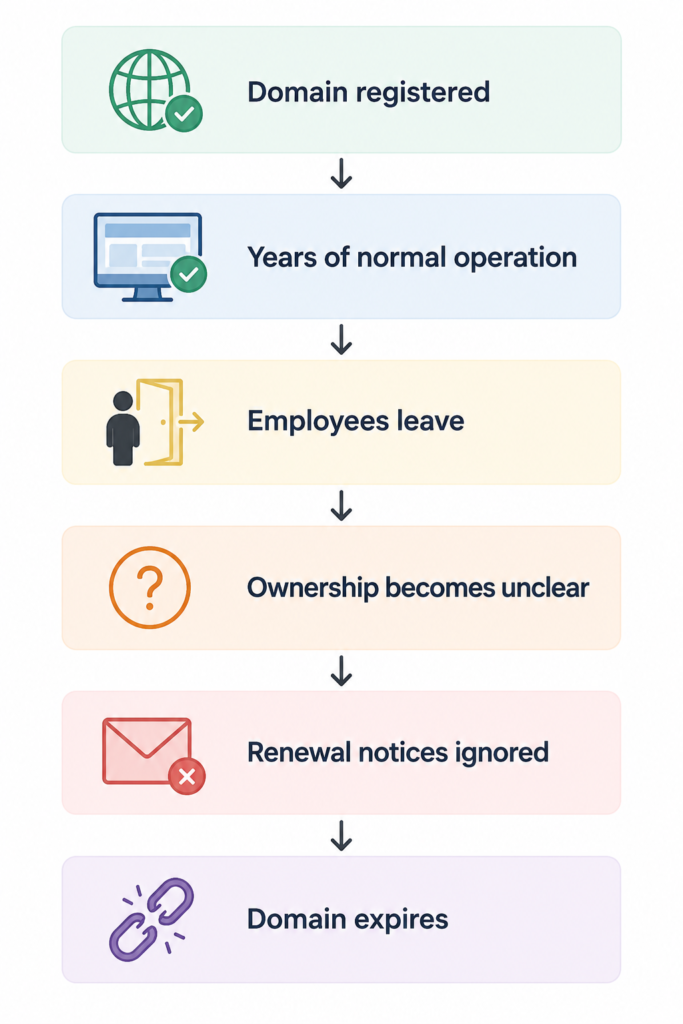
A domain gets registered when a company is founded. Sometimes it is the founder who registers it, sometimes a developer, and sometimes an agency or marketing partner. At that stage, nobody is thinking about what will happen five or ten years later. The goal is simply to launch the project and get the business moving.
Years pass, the company grows, people come and go, responsibilities move between departments, and the domain quietly continues doing its job. The website works, emails are delivered, customers use the application, and everything appears completely normal.
And because nothing appears broken, the domain slowly disappears from everyone’s attention.
How a Domain Becomes Nobody’s Responsibility
Unlike servers, databases, or cloud infrastructure, domains rarely require active attention. When something does not demand attention, people naturally assume that everything is fine.
After a few years, nobody is entirely certain who still has access to the registrar account. The credit card used to register the domain may no longer be active. The email address receiving renewal notices may belong to an employee who left the company years ago. Documentation may exist somewhere, but nobody is confident that it is still accurate.
Because everything continues working, organizations gradually develop the impression that the domain somehow takes care of itself. Then one day somebody asks a very simple question:
Who manages the domain today?
If you asked five people inside the same organization, there is a good chance you would receive five different answers.
And surprisingly often, nobody has a clear answer.
The Problem Isn’t the Expiration Date
When people read stories about expired domains, most of the attention naturally goes to the expiration date itself. After all, that is the moment when the website stops working, emails begin bouncing, or customers start noticing that something is wrong. Yet the expiration date is rarely the real problem. More often than not, it is simply the moment when a much older problem finally becomes visible.
Renewal notices are sent to email addresses that nobody monitors anymore. Payment methods become outdated. Employees who originally registered the domain leave the company. Registrar accounts quietly fade into the background because there is rarely a reason to log in and review them.
Interestingly, after researching some of the most notable domain expiration incidents, it became clear that the same patterns appear again and again. In many cases, the problem isn’t technical at all. It is outdated contact information, expired payment methods, employee turnover, missed renewal notices, or simply the assumption that somebody else is handling the process.
We explored these patterns in more detail in our article 11 Common Reasons Why Domain Owners Fail To Renew Their Domain Name.
If you prefer video content, we also recorded a short discussion covering the same topic and some of the real-world reasons domains fail to get renewed on time.
By the time a domain actually reaches its expiration date, the underlying problem often existed for months or even years. The expiration itself does not create the problem; it merely exposes it.
This Has Happened to Much Larger Organizations
If this sounds like a problem that only affects small companies, history suggests otherwise.
Over the years, we have seen a surprising number of well-known organizations experience disruptions after domains were not renewed on time. Microsoft, Foursquare, Regions Bank, Dallas Cowboys, and several other organizations found themselves dealing with issues that ultimately originated from something as seemingly simple as a domain registration.
What makes these examples particularly interesting is that some of these organizations were serving millions of users when the incidents occurred.
We covered some of the most notable examples in 5 All-Time Domain Expirations in Internet’s History.
What makes these examples interesting is not the expiration itself. Large organizations have infrastructure teams, security teams, operational procedures, compliance requirements, and clearly defined processes. Yet domains can still become orphaned assets when responsibility slowly becomes unclear or gets lost between departments over time.
The lesson is not that domains expire.
The lesson is that organizations sometimes lose track of who is responsible for them.
When a Domain Becomes Infrastructure
What makes this issue more important today than it was twenty years ago is the simple fact that modern infrastructure depends on domains in ways that many people never stop to consider.
A modern company does not use a domain solely for its website. The same domain is often connected to email services, authentication systems, SSL certificates, APIs, customer portals, internal applications, and countless integrations running quietly in the background every day.
When a domain becomes unavailable, the consequences rarely stop at a homepage that no longer loads.
For that reason, I increasingly see domains as infrastructure assets rather than administrative assets. They may not receive the same attention as databases or cloud platforms, but many of the systems businesses rely on every day begin with a domain name.
A Risk That Is Surprisingly Easy to Prevent
The good news is that most of these situations are highly preventable.
Unlike many infrastructure failures, domains provide warning signs long before anything breaks. Expiration dates are known in advance. Ownership records can be verified. Renewal procedures can be reviewed. Potential issues can often be identified months before they develop into incidents.
Organizations that periodically review ownership records, verify access to registrar accounts, and monitor expiration dates are rarely surprised by domain-related issues.
If you are not entirely sure when your domain expires, checking the expiration date is usually much easier than people expect. We recently put together a short guide explaining how to check a domain expiration date and what information you should verify while you’re there.
Many organizations solve this problem by implementing domain expiration monitoring, ensuring they receive alerts long before an important domain reaches its expiration date. If you are considering a similar approach, our guide on using a domain expiry checker explains how these tools work and what information they can help you track.
The challenge is rarely a lack of information.
The challenge is remembering to look.
Final Thoughts
Most infrastructure failures we remember involve complex systems. Cloud outages, security incidents, networking problems, and software bugs dominate the conversation because they are technical, visible, and often dramatic.
Domains are different.
They quietly support websites, email systems, authentication services, and countless other business-critical functions while receiving very little attention.
That is why expired domains are rarely about a missed payment or a forgotten renewal notice. More often, they reveal a much older problem: an important asset that everybody depends on, but nobody is actively managing anymore.
By the time the domain expires, the real problem has usually existed for years.