
If someone asked you to describe a phishing attack, there’s a good chance you would imagine a sophisticated cybercriminal, advanced malware, and a carefully planned operation designed to bypass security systems. The reality is often much less dramatic.
Many successful phishing campaigns begin with something surprisingly simple: a newly registered domain. Once the domain is in place, the rest becomes much easier. A convincing website, a familiar brand name, and a message sent at the right moment are often enough to persuade someone to click.
That might sound almost too simple, but it helps explain why phishing continues to be one of the most successful forms of online fraud.
Trust Is the Real Target
If we look at major phishing campaigns over the past several years, the same names appear again and again. Microsoft, Google, PayPal, Amazon, and recently Booking.com are just a few examples of brands that attackers regularly attempt to imitate. The reason is simple.
Millions of people use these services every day. They receive emails from them, log into their accounts regularly, and are accustomed to interacting with them.
When a message appears to be a Microsoft login alert, a Booking.com reservation confirmation, or a payment verification request, most users do not immediately assume they are looking at a scam.
Most phishing campaigns do not try to create new trust. They take advantage of trust that already exists.
Why Travel-Related Scams Are So Effective
One of the more interesting examples in recent years involved phishing campaigns associated with Booking.com.
If you’ve ever planned a trip, you already know how much communication takes place between the moment you make a reservation and the day you arrive. Reservation confirmations, hotel messages, check-in instructions, reminders, and payment notifications are all a normal part of the process.
This is exactly why these campaigns were so effective.
Attackers sent messages related to reservations, accommodations, and payments. In many cases, the websites themselves were not particularly sophisticated. What made them convincing was not the technology behind them but the context in which they appeared.
When users are expecting information about an upcoming trip, they are naturally more likely to open a link without carefully examining every detail.
This is not merely a theoretical problem. Booking.com has repeatedly warned about phishing campaigns targeting travelers and accommodation providers through fake messages related to reservations and payments. These incidents demonstrate how effective scams can be when they exploit trust that already exists between users and well-known platforms.
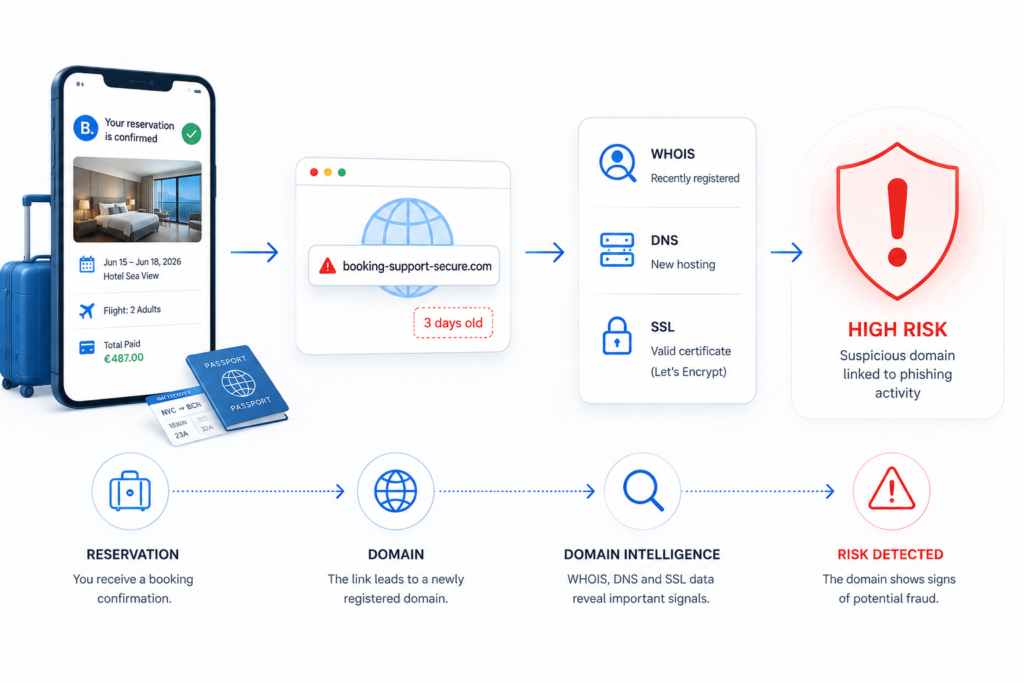
Perhaps that is the most important lesson modern phishing teaches us. Attackers do not create trust. They exploit trust that is already there.
HTTPS Is No Longer Enough
For many years, one of the most common pieces of security advice was to look for the padlock icon in the browser before entering sensitive information. I remember when we used to pay extra cash for an EV SSL on whoapi.com which provided extended validation (EV)! Literally on the green padlock you could see that whoapi.com was operated by none other than WhoAPI Inc.
The biggest change happened when browsers like Google Chrome and Mozilla Firefox removed the prominent green company name display from the address bar. Once users stopped seeing a visible difference, the marketing value of EV certificates collapsed.
Obtaining an SSL certificate has become fast, inexpensive, and often completely free. As a result, many phishing websites use valid SSL certificates and HTTPS encryption. To an ordinary user, a phishing website may appear just as secure as the legitimate website it is imitating.
The problem is that an SSL certificate confirms that communication is encrypted. It does not confirm that the organization behind the website is legitimate.
In other words, a phishing website can look secure while still being part of a fraudulent operation.
This is why website legitimacy can no longer be evaluated solely by what is visible in the browser.
Every Phishing Campaign Leaves a Trail
One interesting aspect of phishing campaigns is that they often leave a digital trail long before users ever receive the first message.
Before a campaign becomes active, domains need to be registered, DNS records configured, infrastructure deployed, and SSL certificates issued. All of these activities generate data that can help security teams evaluate potential risks.
Imagine receiving what appears to be a hotel reservation confirmation. You click the link and arrive at a website that looks completely legitimate. The design is professional, HTTPS is enabled, and the content matches exactly what you would expect to see after making a reservation.
Most users would stop their investigation there. A security analyst is usually just getting started.
Questions such as when the domain was registered, who registered it, when the SSL certificate was issued, and how the DNS infrastructure is configured often reveal information that is invisible to ordinary users. This is where Whois data becomes particularly useful.
In practice, it often takes only a few seconds to determine whether a domain was registered ten years ago or ten days ago. That information alone does not prove malicious intent, but it provides valuable context. If a domain impersonating a globally recognized brand appeared only a few days ago, security teams will typically pay much closer attention.
Returning to our previous example, the website may look convincing and use HTTPS, but Whois data might reveal that the domain was registered only days ago and that its SSL certificate was issued immediately afterward.
Of course, domain age alone does not prove anything. Every legitimate business once registered its first domain.
However, when a newly registered domain suddenly begins impersonating a global brand, that information becomes much more relevant.
This is one of the reasons domain intelligence has become an increasingly important part of modern security strategies. Domain history, registration dates, DNS configurations, and certificate data often reveal information that cannot be seen by simply visiting a website.

The Same Data Helps Solve Legitimate Problems
Interestingly, the same information is not only useful for identifying phishing campaigns.
In our recent article, The Hidden Email Failure Costing SaaS Companies Revenue, we described a situation where legitimate business emails failed to reach their destination because forwarding rules and DMARC authentication created unexpected delivery issues.
At first glance, this appears to be a completely different problem.
In one case, we are trying to identify fraudulent communications. In the other, we are trying to ensure that legitimate communications are trusted and delivered successfully.
Yet the underlying infrastructure is remarkably similar.
- Domains.
- DNS records.
- SPF and DKIM configurations.
- SSL certificates.
Trust signals that help systems determine whether communication should be accepted or rejected. Whether we are analyzing phishing campaigns or troubleshooting email delivery problems, the fundamental question remains the same:
Can the infrastructure behind a domain be trusted?
Security Does Not End at Your Website
Many organizations still view security primarily through the lens of their own infrastructure. They focus on protecting applications, user accounts, and internal systems, which is entirely reasonable.
The challenge is that many threats originate outside of that infrastructure.
An attacker does not need to compromise an organization’s official domain to exploit its reputation. In many cases, registering a similar domain, using a typo variation, or choosing an alternative extension is enough to create confusion.
This is why domain monitoring and brand protection have become increasingly important parts of modern security programs. Organizations that actively monitor newly registered domains related to their brands have a much better chance of identifying threats before those threats reach customers.
Final Thoughts
Perhaps the most interesting thing about phishing in 2026 is how little the core concept has changed.
Technology has evolved. Security systems have become more sophisticated. Users are more aware of online threats than ever before.
Yet phishing continues to succeed because it relies on something that technology alone cannot easily solve: trust.
That is why some of the most valuable security insights are often found not on the website itself, but in the data behind it. Whois records, DNS configurations, SSL certificates, and domain history frequently tell a story that the website alone cannot.
And very often, that story begins with something surprisingly simple:
A domain registration.