
After more than a decade of working with domain data at WhoAPI, I have noticed that many SaaS products already collect useful information about a company without making much use of it. One of the clearest examples is the company domain.
It usually appears during registration, onboarding, or account setup. The user enters a website address, the product stores it, and the process continues. In many cases, the domain remains nothing more than a text field in a database.
Yet it can reveal whether a domain is registered, when it was created, which nameservers it uses, and how its DNS is configured. The opportunity is not to show users a complete WHOIS record or turn every SaaS application into a domain research tool. It is to use relevant domain data inside a workflow that already exists.
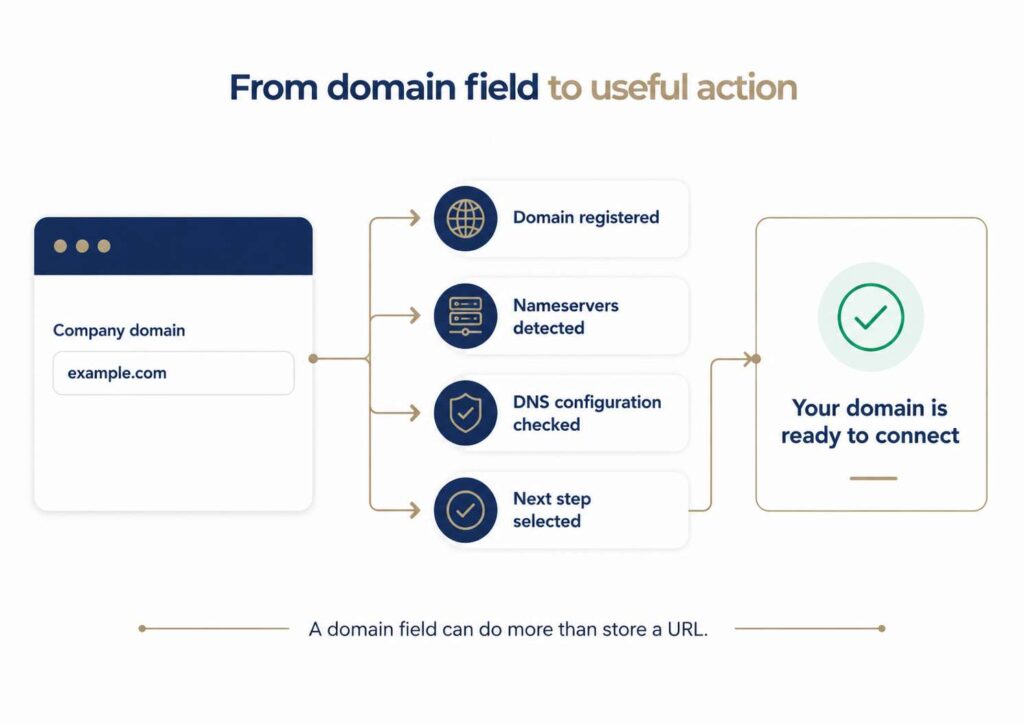
A Domain Can Determine the Next Step
Consider a web hosting company onboarding a customer who wants to connect an existing domain to a new hosting account.
The usual process is predictable. The customer receives general instructions for changing nameservers and is told to wait for DNS propagation. If something does not work, support eventually checks the domain manually and tries to determine what went wrong.
However, the company already received the domain name at the beginning of the process. Before displaying the next step, the platform could check which nameservers are currently in use and whether the necessary changes have already been made.
If the domain still points to another hosting provider, the software can explain what needs to change. If the correct nameservers are already configured, it can avoid showing irrelevant instructions and move the customer forward.
The same principle applies to other SaaS products. An email platform may check whether the required DNS records have been configured before allowing a customer to continue. A website builder may determine whether a domain is registered and ready to connect. A sales platform may add basic domain information to a company profile without asking the user to complete another form.
In each case, domain data supports a process that already exists. The product does not need to introduce an entirely new workflow. It simply uses information from the domain to make the next step more relevant.
The API Response Is Not the Feature
At WhoAPI, we have seen that retrieving one field is rarely the difficult part. The real work begins when a product has to decide what that field means and what should happen next.
When developers first connect to a domain API, the response naturally receives most of their attention.
It may contain a creation date, expiration date, registrar, nameservers, registration status codes, DNS records, and other technical fields. From a developer’s perspective, these details are useful because they show what information is available and how it can be processed.
The customer sees the situation differently.
A hosting customer does not care which nameservers the API returned; they care whether the domain is connected correctly. An email user does not want to inspect raw DNS output; they want to know which record is missing and what needs to be added.
In both cases, the value lies in the conclusion, not the raw response.
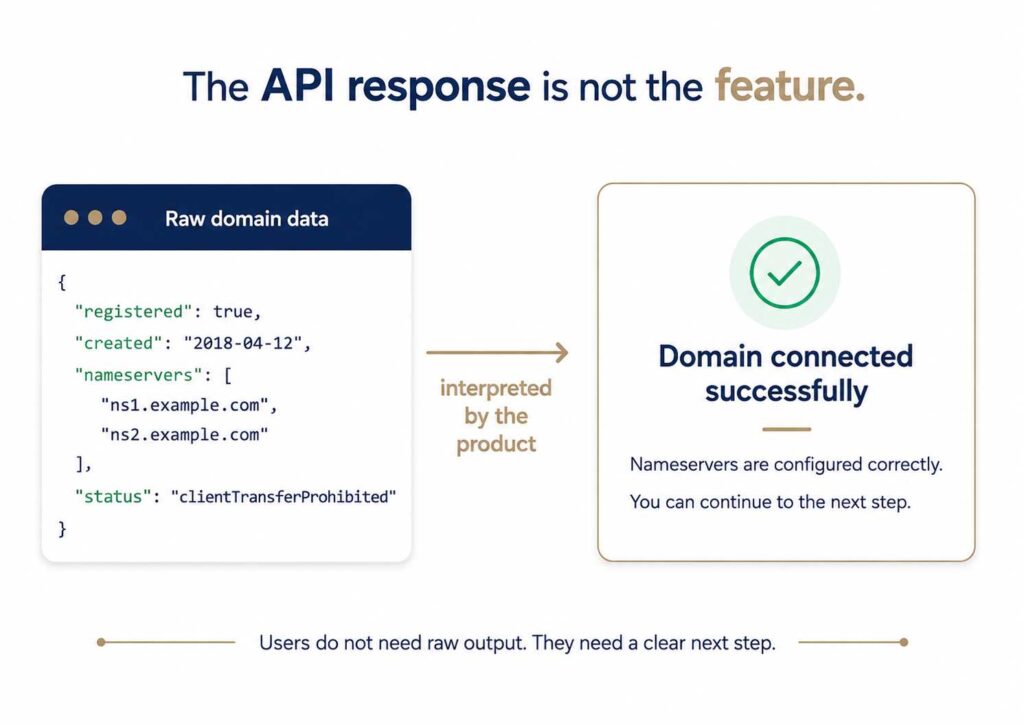
A useful integration translates technical information into a message, recommendation, warning, or automated action. It decides which information matters at that moment and leaves out everything that would only create confusion.
This becomes even more useful when the product monitors changes over time. Nameservers change, DNS records are added or removed, and registrations approach expiration. A hosting platform may continue onboarding once the correct nameservers appear, while a domain management tool may warn the customer before a renewal deadline becomes urgent.
The customer does not need to perform the same check repeatedly. The software can observe the domain in the background and respond when something important changes.
The SaaS team still has to decide when a domain should be checked, which fields are relevant, and what should happen when something unusual appears. The API provides the information, but the product is responsible for turning that information into value.
Domain Data Needs Context
Domain data can be useful, but it is also easy to misinterpret.
An older domain does not automatically indicate a trustworthy company, just as a newly registered domain is not automatically suspicious. Ownership changes, periods of inactivity, and routine technical updates can all affect what the data means.
A nameserver change may indicate a hosting migration, but it may also be ordinary maintenance. A missing DNS record used for email may indicate an incomplete configuration, but it says little about the company itself.
This is why domain information works best as part of a broader picture. A SaaS product may already have customer details, account activity, company records, payment history, or email behavior. Domain age, DNS configuration, registration status, and nameserver changes can add context to that information, but they should not replace it.
The goal is not to replace judgment with an API response, but to make better decisions with information that is already available.
When a Lookup Becomes Infrastructure
Checking one domain can appear straightforward. A developer sends a request, reads the response, extracts the required field, and stores the result.
The complexity becomes more visible when the product needs to process thousands of domains across hundreds of extensions. Registries return different amounts of information, response formats vary, and privacy rules limit some registration details. Timeouts, rate limits, caching, normalization, and error handling eventually become part of the system.
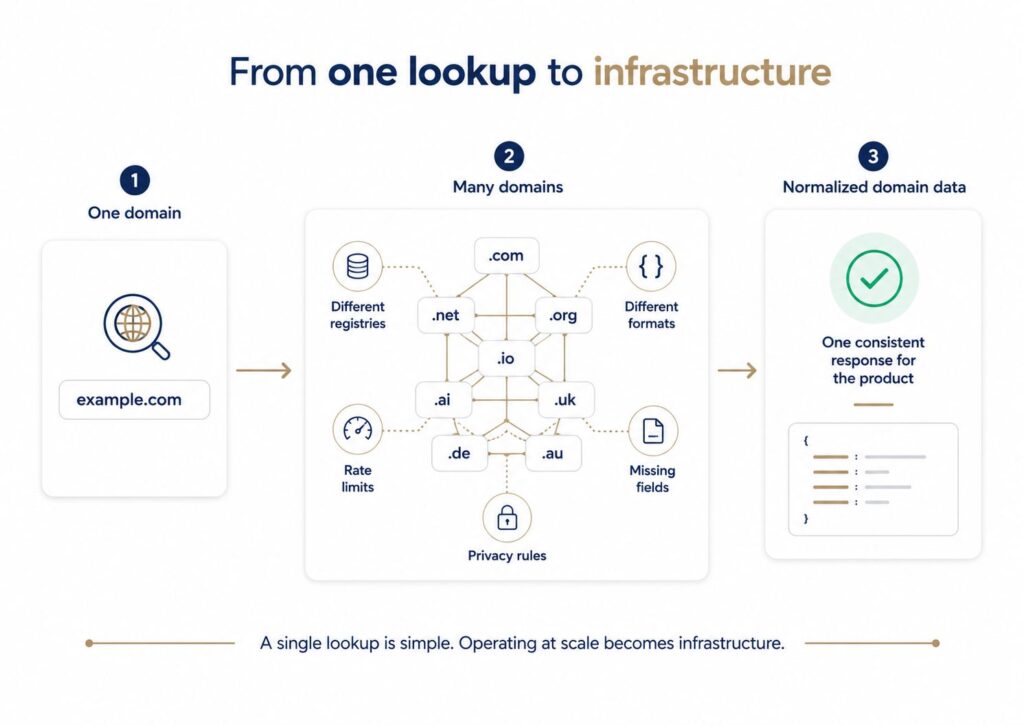
What began as one lookup gradually becomes infrastructure that has to be maintained.
A SaaS company can build this infrastructure internally, but it should first ask whether maintaining registry connections and normalizing domain records is part of the value customers actually buy.
In most cases, it does not.
A hosting platform creates value by making websites easier to launch and manage. An email service creates value by helping customers configure their domains and send reliably. A sales tool creates value by helping teams understand their prospects.
Domain data may improve each of those products, but collecting and standardizing the underlying information is rarely their competitive advantage.
Using an API allows the team to focus on what customers actually experience: the onboarding logic, warning, recommendation, or automated action that follows after the data is received.
That is usually where the real feature begins.
Conclusion
Many SaaS products already ask users for a company domain, but treat the answer as little more than text that needs to be stored. Customers do not need to see the WHOIS response, DNS records, or nameserver history behind a feature. They need the product to recognize the situation and provide the right next step.
Domain data will not improve every workflow, and it should not replace broader customer information or judgment. But when a domain is already being collected, it is worth considering whether the product could use it more intelligently.
The opportunity is not to collect more data.
It is to make better use of a field the product already has.