
I spend a lot of time working with domain data. DNS can show where a domain points, but not what software is running on the server. We explain what DNS can and cannot show in our guide, What Is DNS and How DNS Works?. PHP2Shell brought that limitation into focus.
On October 21, 2026, PHP released patches for two vulnerabilities, CVE-2026-109618 and CVE-2026-109619. Under certain conditions, they could let an attacker execute code on a server without logging in. Both received a CVSS 4.0 score of 9.2. PHP’s security advisory said installations serving web requests were at risk, with Apache’s mod_php configuration presenting the highest risk.
WordPress is an application; PHP is the runtime that executes its code on the server. They can be updated separately. Updating WordPress does not confirm that the PHP running it has been patched.
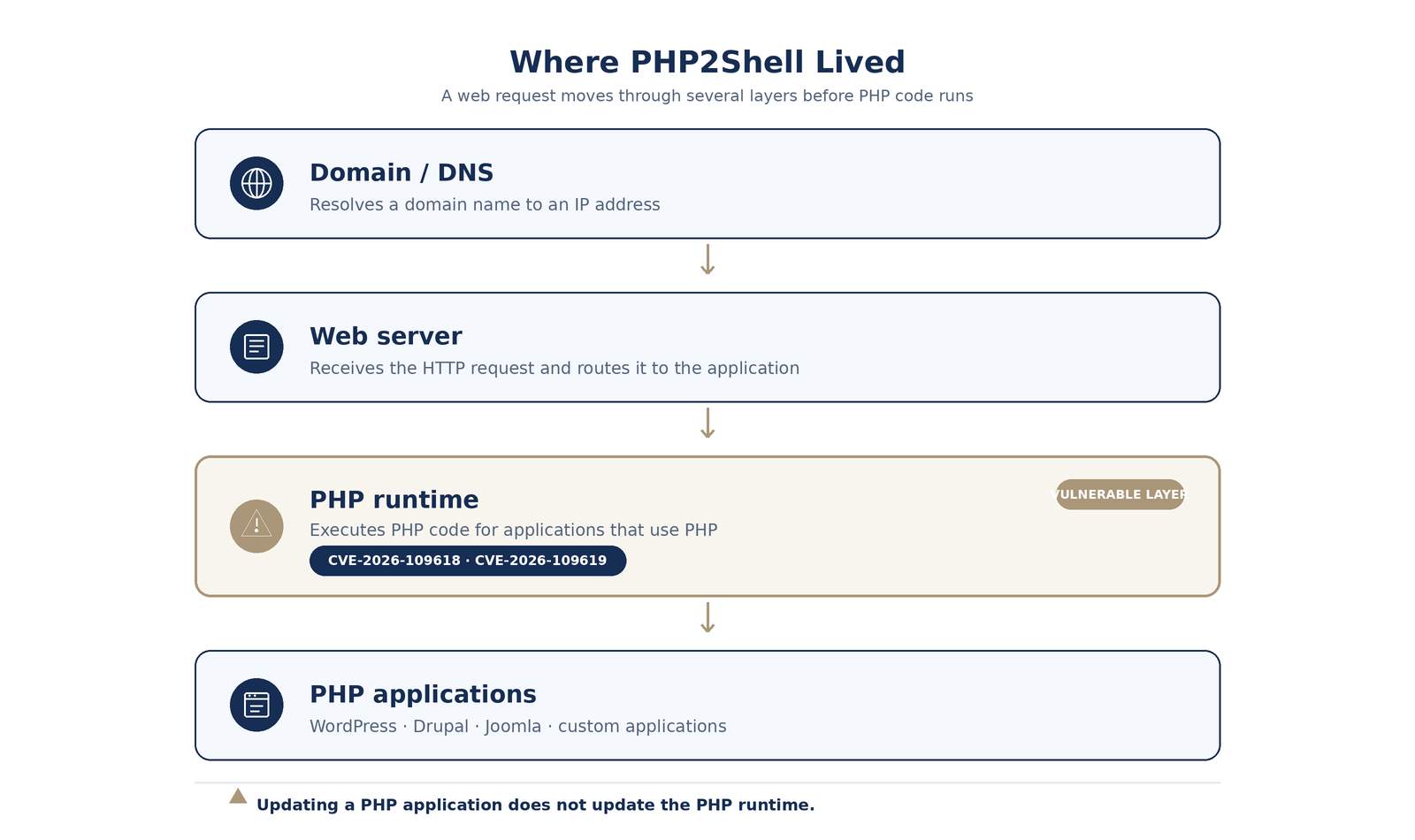
That does not mean every site using PHP was compromised. The vulnerabilities were in technology shared by many applications, and exposure depended on the PHP version and server configuration.
The flaws occurred while PHP processed requests
PHP uses memory to process each web request. CVE-2026-109618 could be triggered when a request hit PHP’s configured memory limit while PHP was still processing input, such as a multipart file upload. This could leave internal request data only partly initialized. During cleanup, PHP could then try to free memory that had not been properly initialized.
The second flaw involved internal state that remained accessible after the memory it used had been released. PHP servers often use long-running processes, or workers, to handle multiple requests in sequence. If the same worker handled another request before PHP reset that state, a later operation could use the stale data.
Researchers demonstrated both memory disclosure and remote code execution, although the available exploit paths depended on the PHP setup. CERT-EU’s technical advisory explains how the flaws worked. PHP also said that a demonstrated attack against mod_php could begin before the application’s own code ran.
The patch had to reach PHP
PHP released fixes in versions 8.5.12, 8.4.27, 8.3.36, and 8.2.35. Administrators needed to check which version the server was running, apply the appropriate update, and confirm that the patched PHP was actually in use.
Finding every affected installation could be harder than applying the patch. PHP may be part of a hosting stack or another product, rather than something a site owner manages directly. CERT-EU warned that commercial and open-source products using PHP in the backend could also be affected. Older systems add another complication: Linux distributions and long-term support providers may backport a fix without changing the version number. In these cases, the hosting provider or software vendor may need to confirm which update applies.
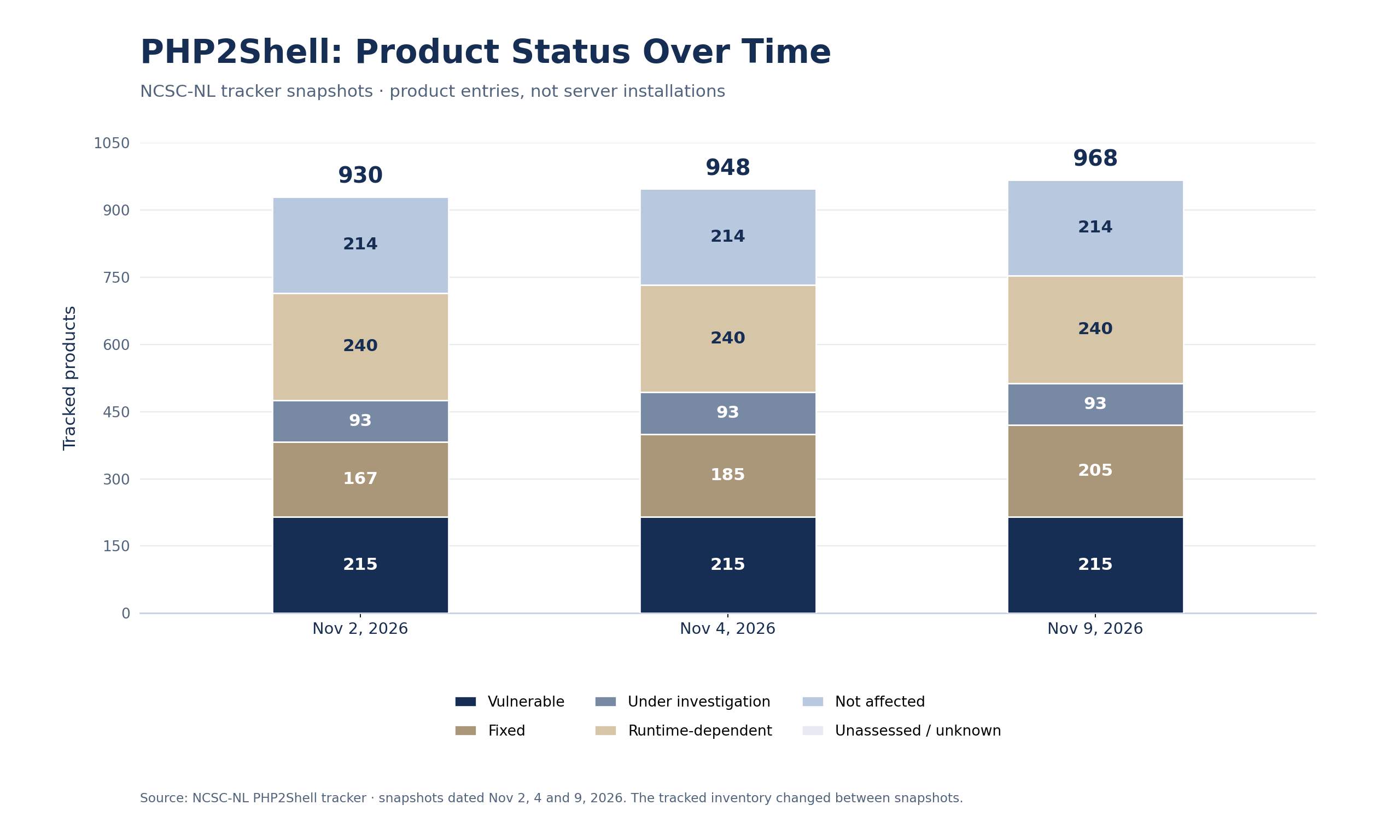
On October 23, PHP also issued an advisory about CVE-2026-115560, a separate vulnerability that requires an unusual combination of settings and application behavior. It was not covered by the October 21 patches. As of November 12, PHP’s October 23 notice still recommended temporarily disabling session.upload_progress.enabled until the next regular bug-fix release.
Reports of exploitation had different scopes
On October 26, CISA added both CVEs to its Known Exploited Vulnerabilities catalog. The following day, Wiz reported a limited number of exploitation attempts in its own telemetry, but said it had not observed successful end-to-end PHP2Shell exploitation in that telemetry. Wiz also said that partners had privately reported working exploits against multiple targets. These reports describe different evidence: CISA’s KEV listing reflects known exploitation, while Wiz’s account covers activity visible to its own systems.
AI was a tool in the research
OpenAI says the Calif research team identified one critical flaw with help from GPT-5.6 Sol. Wiz says its researchers independently discovered both vulnerabilities and used AI models in their analysis. PHP’s maintainers developed and released the fixes.
I would not describe this as AI finding the vulnerabilities and solving the problem on its own. What stands out to me is the disclosure timeline: Wiz says it reported its findings in August, giving PHP’s maintainers time to investigate and prepare fixes before they were released publicly on October 21.
Conclusion
PHP2Shell began in a shared runtime beneath applications such as WordPress. Responding to it meant finding the affected PHP installations, identifying who maintained them, and confirming that the update was active. A published patch is only part of that process.